
Clockwork Marmalade - A Short Story
CHAPTER ONE: Like Clockwork

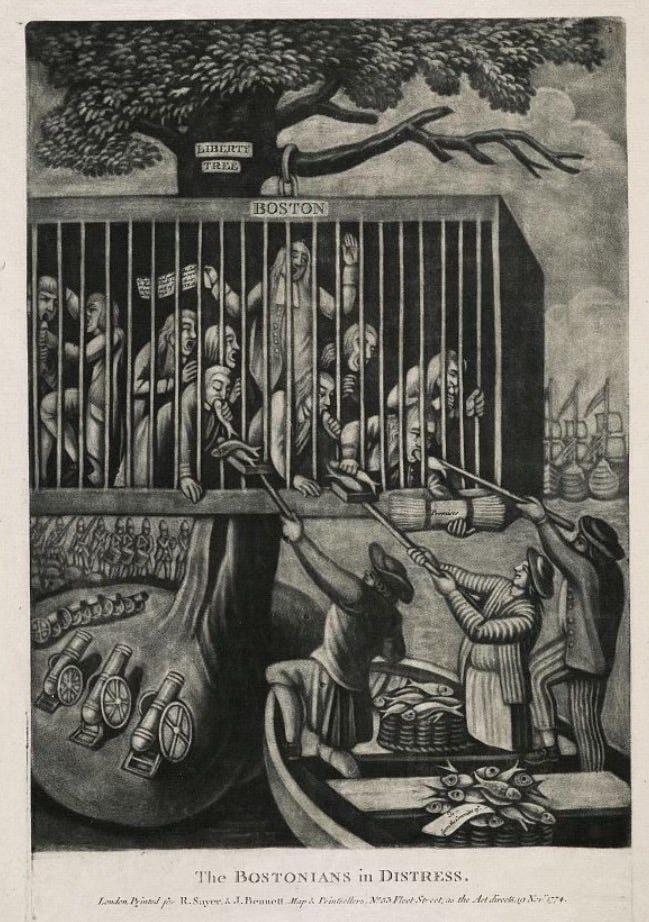
The Bostonians in distress. [London?: ?] Photograph. Retrieved from the Library of Congress, <www.loc.gov/item/2011647025/>.
It was a bright, cold day in April–or August, or even October! –and the clocks were striking thirteen. All at once, a cacophony of chimes, rings, and dings melded together in a glorious– oh, what am I doing?!
There are no clocks, none, and I have lost track of time. Counting the seconds does not work–or perhaps it did? –as I begin, as one does, at 0, the undisputed starting number (Who in their right mind gave wretched zero the first place in line? Hadn’t they heard the desperate cries of lovely 14,000?), then move to 850, 12, 2, 6, fourteen-eight, and so on, until the smell of fresh fish jolts me out of whatever it is for a fresh meal.
I do not mind the nice young fellows–I say young as if I am any older, Ha! Have you considered, dearest parchment-pamphlet paper, that I am only thirty-nine? – who give us our food, their clothes stinking with the smell of freshness and their bellies taut and full like they’ve just come out from a Chichikov dinner (you may ask, dearest parchment, who Chichikov is, and may answer your doubt yourself–I haven’t the faintest clue) who laugh and enjoy prodding us with their shovels.
No, it is not them I hate.
If anything, I pity them.
That man in the back, well-dressed and clean as ever, stands tall over all of us and demands we call him Gage. Do not listen to him, dearest parchment, for he will not divulge his true nature: that he forgoes fish to receive bread when the rest of us have fainted from hunger, that he forgoes clothes to receive freshly tailored garments, scrubbed clean and still warm, while the rest of us rot and roast inside tattered rags.
He is there now, as always, preaching the end of days—or some such triviality—while the others gather around, scribbling his words. They will adjust them later, of course, to fit whatever narrative they have built in their minds.
Come sunrise, they will roll up the papers and thrust them at passersby. They will shove them into the coats of the fellows who give us food. They will wait for word that the message has been heard and spread like the plague, and they will go about writing more.
Such is life in the One State.
I really must stop using the word they.
It makes me forget that I, too, am part of the machine, a cog in the wheel, dispensing facts that I could not believe if I tried.
I should stop saying “I” too, but I cannot help it. I am surprised I still remember it exists. I forget that we are an “us”—that it has been years since––
“Delivery!”
Ah, yes, the Fishermen are here. I could not describe the taste of fish even if I tried. Like bad air. Bad air if it was bleeding and had small bones that got stuck in between teeth and pierced holes in intestines.
Poor things, they are isolated from the rest of the colony when they return home and only have each other for company. Even worse, they do not know what they have become. Or rather, what we have turned them into.
The others work fast, slipping folded-up strips of paper into pockets and money-hungry fingers slick with greed. They shove them elsewhere, too.
Into the trousers, the waistcoat, the mouth, the ears, the stomach next to the rotting fish (they tell us it is fresh; we know it is not) of the corpses and cry and wail like mourners of the royal court in fantasy books. (What have I said, dear parchment, about such questions? You are meant to hold my tale, not question your contents)
It has been put there so that when the autopsy happens, they can thrust the bloody papers at mortified onlookers and say, “Behold the proof of the Fishermen’s truth. He was given nothing but cod for weeks, and by the time of his death, he understood the truth. He was confident of his purpose in life and died happily. Wouldn’t you want that as well? To be sure of yourself? To know that you are a cog in the wheel, being utterly and wholly devoted to the Fishermen?”
More and more people will step forward, then and say, tears in their eyes, “Yes, that does sound lovely, doesn’t it?” and they’ll pull their family along, all happy, smiling, joyful…They eat the cod and throw themselves in the harbour afterwards, choking on tea and attempting to drown each other.
I have often wondered why they resorted to such horrid methods to survive, but I am sated by remembering that relationships are worth nothing. All one needs, of course, is the One State, the only thing that truly exists and is all-encompassing and all-knowing.
The onlookers’ mortification will be gone by then, replaced with paranoia and awe.
A two-minute show will be held later, as it always is, meant to agitate the crowd and get their poor, dead brains spiralling. The spirits of those souls will come back to warn the crowd about eating the fish and drinking the tea, but the people will refuse to care.
They will kick and scream and shout, throw flaming drinks and hurl blunt knives, but deep down, they are simply afraid. Screaming and jeering blocks out the voices, and throwing knives distorts the image.
I have never seen it for myself, of course. I have never been outside.
All I have are the incoherent ramblings of one of the Fishermen who had come to us, scared out of his mind and still in shock from the horrors he had seen the day before. God rest his poor, starved soul. I had been able to see the desperation in his eyes; it seeped out of his pores, its stench hung in the air. Cruel as I am, cruel as Gage has made me out to be, I didn’t have the heart to tell him that the others’ wheezing breaths were laughter, that the tears in their eyes were from disbelief, that by taking pity on them and by giving them more fish and the tiniest morsel of bread he was only encouraging them more to spin more yarns and revere Gage more?
You stupid fool! I had wanted to yell. Don’t you see what you are doing, that your compassion only enrages them more?
He seemed not to hear me, and the gleam in his eye was akin to the one people get when they give a cent to the poor. He thought he was doing something good, even as the others grasped his collar with hands shaking from glee, and poured scalding tea down his throat.
Ah, to hell with this! I can no longer maintain this ruse.
Work resumed gleefully after that, with the others scribbling my words and wrapping the pamphlets with newfound enthusiasm. It was a pity, considering their trembling fingers distorted the words and made them harder to read, but it did not matter.
My words will be read, my doctrine followed, and people will throw themselves into the tea, regardless of whether they truly understand.